
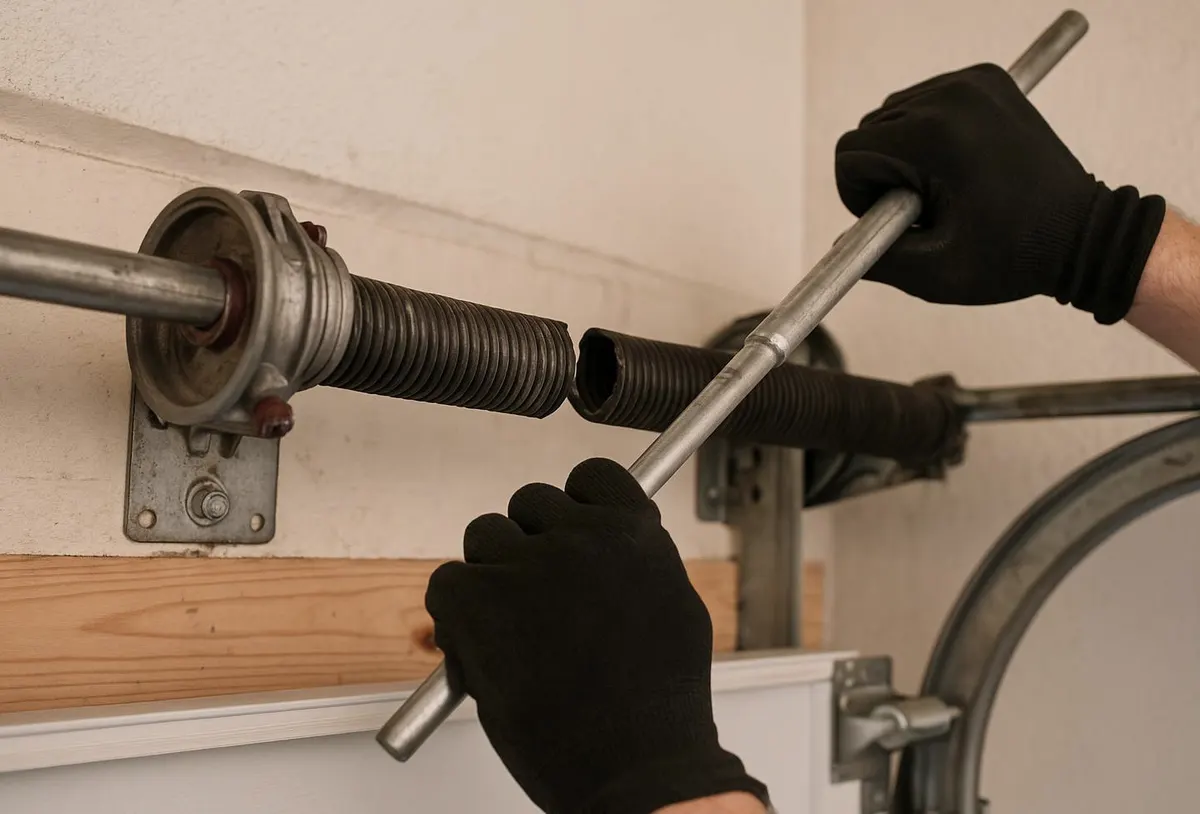
Force and travel limits are two different settings, and getting either one wrong can bend panels, snap cables, or make your door reverse for no reason. Travel limits tell the opener exactly where "open" and "closed" are. Force settings tell the motor how hard to push or pull to get there. If the limits are off, the door stops short or slams too hard. If the force is set too high, the opener muscles the door through problems it should be stopping for. So if you're arguing about which setting is the real culprit, you're probably both a little right.
What Travel Limits Actually Control
Travel limits are the stop points. They tell the opener how far to run the trolley before it decides the door is fully open or fully closed. When these are set wrong, you'll see a door that stops a foot off the floor, reverses right before it touches down, or keeps opening past the point where it should stop and strains against the top of the track.
What Force Settings Actually Control
Force is how much effort the motor applies while moving the door through that travel. It's there to compensate for normal resistance — a little drag from the weatherstripping, the weight of the door itself. The problem starts when the force is cranked up to push through resistance that shouldn't be there at all.
Why the Wrong Settings Cause Real Damage
This is the part that costs money. If force is set too high, the opener stops acting like a safety device and starts acting like a battering ram. A spring that's losing tension, a roller that's binding, or a track that's slightly out of alignment will all create extra resistance — and instead of the opener struggling (your cue to get it checked), it just pushes harder. Over weeks, that extra force bends panels, stresses hinges, and can snap a cable that was already fraying.
Travel limits set wrong cause a different kind of damage. A door that's told to travel past its actual closed position will slam into the floor with real force every single time, which cracks panels and knocks the track out of alignment. One that stops short never seals properly, which matters a lot once summer storms roll back around.
Why This Is Trickier in Tangerine
Humidity swings through the year cause wood and composite doors to swell and contract slightly, which changes how far the door actually needs to travel to seat correctly. A setting that was perfect in a dry stretch can be off by enough to matter after a run of humid, rainy days. Salt air and moisture near the coast also speed up rust on rollers, hinges, and track hardware, adding friction the opener has to work against. If the force setting is already high, that creeping resistance gets masked instead of noticed — right up until something gives. And after any storm with heavy wind load, it's worth checking alignment, since a track that's shifted even slightly changes how much force the door needs to move smoothly.
Signs Your Settings Are Off
- Door reverses partway down for no obvious reason
- Loud bang or slam when the door reaches the floor
- Door stops short and never fully seals at the bottom
- Opener motor sounds like it's straining or grinding during normal operation
- The door doesn't reverse when it meets light resistance, like a stray garden tool
This Isn't Just Annoying, It's a Safety Feature
Modern openers are required to meet a national safety standard (UL 325) that includes auto-reverse: if the door meets resistance while closing, it's supposed to stop and reverse instead of continuing down. That protects kids, pets, and anyone ducking under a closing door. If the force is set too high, the opener may not recognize an obstruction as resistance at all, which defeats the whole point of the feature. This is why "just turn the force up until it stops complaining" is the wrong move, even if it technically makes the noise go away.
How to Actually Check Who's Right
- Lay a 2x4 flat on the ground where the door closes. Run the door down — it should stop and reverse on contact, not push through it.
- Watch a full open-and-close cycle. Listen for grinding, hesitation, or a motor that sounds like it's working harder than it used to.
- Check that the door closes flush to the floor and opens fully without straining at the top.
- If adjustment is needed, the force and travel dials or buttons are on the opener's motor housing — make small changes and retest after each one, not all at once.
- If the door won't hold a setting, or you have to keep increasing force to get the same result, that's not a settings problem anymore — something mechanical is working against the opener.
When to Call Precision Garage Door of Tangerine
If your door is slamming, reversing randomly, or the opener sounds like it's fighting the door every cycle, stop adjusting the force dial and have it looked at. We check springs, rollers, and track alignment as part of a Garage Door Tune-Up & Maintenance visit, because force and travel settings only make sense once the mechanical side is sound. If a frayed or snapped cable is part of what you're hearing, our Garage Door Cable Repair service handles that safely, since cables under tension aren't a DIY fix.
If you're in Tangerine, Apopka, Zellwood, Mount Dora, Eustis, Tavares, Sorrento, or Plymouth and your opener settings don't seem to be holding, give Precision Garage Door of Tangerine a call. We'll find out whether it's the settings, the hardware, or both — and settle the argument for good.